3:18
From the channel archive
The late Ali Karim at the signing of The Complete Guide to Arabic Names
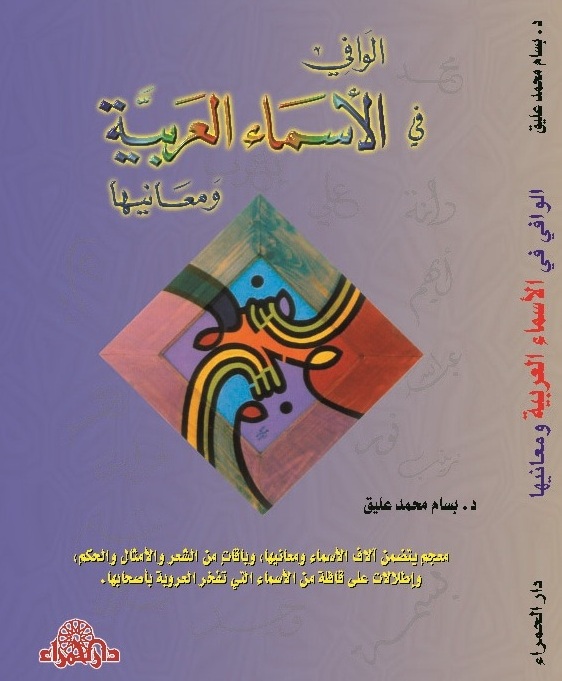
Ali Mahmoud Karim's address at the 2000 signing of The Complete Guide to Arabic Names and Their Meanings.
Watch the videoBooks and recordings remain in their original language; translations cover the website's text.
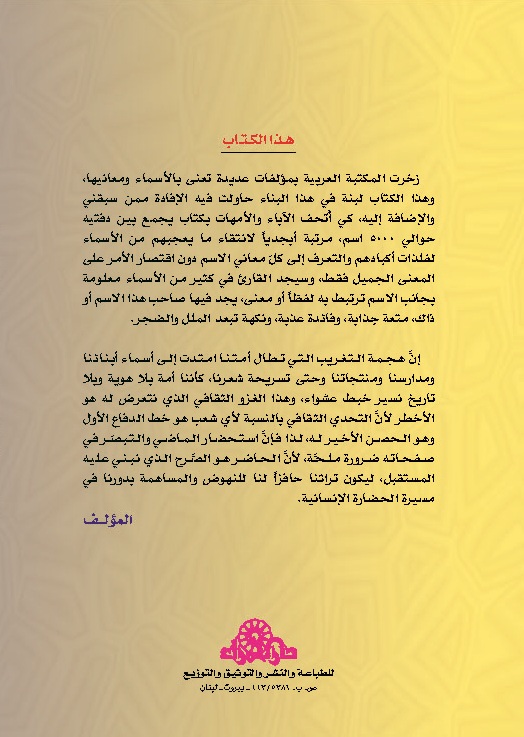
The unity of names in their linguistic and historical roots is an important factor in the unity of society and the cultural unity of the nation. This prompted this modest attempt, my contribution to returning to the roots of our heritage and the authenticity of our beautiful language. I have tried to give each name all its meanings relating to a human being, an animal or a thing, so that readers may know the meanings of their names in full.
The unity of names in their linguistic and historical roots is an important factor in the unity of society and the cultural unity of the nation. This prompted this modest attempt, my contribution to returning to the roots of our heritage and the authenticity of our beautiful language. I have tried to give each name all its meanings relating to a human being, an animal or a thing, so that readers may know the meanings of their names in full.
Since childhood, names and their meanings have stirred my feelings. But my perspective has changed from the curious outlook of that boy from Amila who admired the beauty of names and their Arabic language. The subject has taken on other dimensions, centred on two fundamental aspects:
1- The human dimension: this concerns the choice of the name itself and its negative or positive influence on a person. Sociology, education and psychology have established that a name has considerable effects on an individual's personality, formation, development and interaction with oneself and society.
Scholars and specialists therefore advise choosing names with care and love. Names that invite ridicule or are unfamiliar in meaning or sound hurt their bearers and have harmful psychological effects. They mark their lives with isolation and feelings of inferiority, sometimes expressed as aggression towards themselves, their families or society in general. Superstitious ideas held by some parents have often made their children regular visitors to psychiatric clinics, or brought them into disputes before the competent courts because of the degrading names they were given.
2- The national dimension: we all see that Westernisation targets our nation in every field, extending to the names of our children, factories and products, and even our hairstyles, as though we were a nation without identity or history, stumbling blindly through this world.
This pathological phenomenon expresses a dark corner of the Arab mindset that sees blind imitation of the West as a solution to our problems. This outlook arises from feelings of inferiority and defeat before everything foreign. It calls on all who care to contribute in their own way to confronting this invasion of our region and our people, which has continued since ancient times, sometimes subsiding and sometimes flaring up again.
The cultural invasion the nation currently faces is the most dangerous and expresses itself in different forms. For any people, culture and the cultural challenge are its first line of defence and its last fortress.
Islam has paid special attention to naming. Researchers find many calls in Islamic heritage to choose good names and reject ugly ones. The Quranic verses addressing this subject clearly indicate its importance for humanity. In al-A'raf, verse 180: {To God belong the most beautiful names, so call upon Him by them..}; in al-Baqara, verse 31: {He taught Adam all the names, then presented them to the angels and said: Tell Me the names of these, if you are truthful}; in Al Imran, verse 36: {..I have named her Mary, and I seek Your protection for her and her offspring from Satan, the accursed}; in Al Imran, verse 45: {When the angels said: O Mary, God gives you glad tidings of a word from Him, whose name is the Messiah, Jesus son of Mary, honoured in this world and the Hereafter, and among those brought near}; in al-Najm, verse 23: {They are only names you and your fathers have named..}; in al-Saff, verse 6: {When Jesus son of Mary said: O Children of Israel, I am God's messenger to you, confirming the Torah that came before me and bringing glad tidings of a messenger to come after me whose name is Ahmad. But when he came to them with clear proofs, they said: This is manifest magic}; and in Maryam, verse 7: {O Zechariah, We give you glad tidings of a boy whose name is Yahya. We have not given this name to anyone before}....
There are also many sayings of the Messenger of God, peace and blessings be upon him, recommending the best names, including: "On the Day of Resurrection you will be called by your names and your fathers' names, so make your names good"; "Name yourselves after the prophets. The names most beloved to God are Abd Allah and Abd al-Rahman, the truest are Harith and Hammam, and the ugliest are Harb and Murra"; "If you name a child Muhammad, honour him, make room for him in gatherings, and do not treat his face with disdain"; "A child has the right to have his father teach him writing, give him a good name and arrange his marriage when he comes of age"; "Aaron named his two sons Shabbar and Shabbir, and I named my two sons al-Hasan and al-Husayn"; "The first gift one of you gives his child is a good name, so let each of you give his child a good name"; "Whoever has three sons and does not name one of them Muhammad has shunned me"; "The name I love most is Hamza"; "Name your son Abd al-Rahman"; "Use my name, but do not use my kunya".
Imam Ali ibn Abi Talib, peace be upon him, said: "A parent has a right over his child, and a child has a right over his parent. The parent's right is that the child obey him in everything except disobedience to God, glorified be He. The child's right is that the parent give him a good name, raise him well and teach him the Quran"; "When you name, use names expressing servitude to God".
Among Muslims, it is recommended to name every newborn Muhammad for at least seven days. Ja'far al-Sadiq, peace be upon him, said in this regard: "No child is born to us without our naming him Muhammad. After seven days, we change it if we wish, or otherwise keep it".
Ibn Abbas said: "On the Day of Resurrection a caller will call: Let everyone named Muhammad stand and enter Paradise in honour of his namesake Muhammad".
Arab sages said: "A child has the right to have his father choose a noble mother for him, give him a good name and teach him reading and writing".
Abd al-Muttalib ibn Hashim ibn Abd Manaf, grandfather of the Arab Messenger, peace and blessings be upon him, was asked: What did you name your child? He answered: Muhammad. He was asked: How did you give him a name borne by none of your ancestors or your people? He replied: I named him Muhammad because I hope that all the people of the earth and the inhabitants of heaven will praise him.
The books of the Prophet's noble biography relate that the Messenger, peace and blessings be upon him, replaced many ugly names of people and places with good ones. He changed Asiya to Jamila, Harb to Salam, and Hazn to Sahl. He changed Abu Bakr's name, may God be pleased with him, from Abd al-Ka'ba to Abd Allah; Ibn Awf's from Abd al-Harith to Abd al-Rahman; Barra, daughter of Umm Salama, to Zaynab; Banu Ghayyan to Banu al-Rashdan; Banu Mu'awiya to Banu Murshida; Banu al-Riba to Banu al-Rushda; the city of Yathrib to Tayba; and Shi'b al-Dalala to Shi'b al-Huda...
The poet said:
We have names that suit no others, and scenes that light up when they see us.
Choosing a name is subject to particular circumstances within each family. Many factors, difficult to pin down, enter into this choice. I will try to mention the main ideas that occur to parents when they face this question:
1. Religious factors are an important source for a broad range of people when choosing names for their children. These include compound names, most of which express servitude to God Almighty (Abd al-Rahim, Abd al-Salam..), or are joined to God's name to seek blessing (Nasr Allah, Amat Allah, Khayr Allah..), or include Muhammad (Muhammad Ahmad, Muhammad Ali..), or are joined to the word din, religion (Ala al-Din, Nasir al-Din..), or to Islam (Sayf al-Islam, Majd al-Islam..). Others use the names of prophets (Muhammad, Isa, Yusuf, Yunus, Ibrahim..), members of the Prophet's household, peace and blessings be upon him (Ali, al-Hasan, al-Husayn, Fatima...), companions (Abu Bakr, Miqdad, Bishr, Yasir, Umar, Salman..), holy figures, saints and leaders of conquests (Tariq, Maryam, Khalid, Qutayba, Ubayda, Maroun..), or early Muslim women (Khadija, Aisha, Zaynab, Ruqayya, Amina, Umm Salama, Umm Kulthum..).
There is a category of names expressing devotion to someone other than God Almighty and His beautiful names. Their purpose is to seek blessing and honour their bearers, rather than servitude in its usual sense (Abd Ali, Abd al-Masih, Abdat al-Zahra..). Some people also draw names from the Holy Quran, seeking blessing in the words of God, mighty and glorious (Kawthar, Tasnim, Ramadan, Maryam, Islam, Ayat, Ala..). Safi al-Din al-Hilli said in praise of the household of the Messenger, peace and blessings be upon him:
They have lofty names, plainly known; because of them, a name came to be called a proper name.
2- In the past, Arabs had many ways of choosing a newborn's name, including:
- Naming the newborn after the first thing the person choosing the name saw (Rim, Zabya, Ghazal, Muhr, Dhi'b, Thu'ala..).
- Giving names that instil terror and fear in listeners' hearts, convey strength and inspire awe (Ghadanfar, Junadil, Layth, Sakhr, Sha's, Awsaja, Dhi'b..), while giving their male and female slaves the most delicate and gentle names (Fayruza, Yaqut, Maysun, Rayhana, Yusr, Yumn, Anbar, Kafur..). Arab sages explained the harsh names of their children or tribes by saying: Our children's names are for our enemies, while the names of our male and female slaves are for us.
- Arabs often took names from things and phenomena in nature, such as (Falak, Qamar, Shams, Su'ud, Najma, Kawkab, Bahram, Matar, Hilal, Rabi', Zilzal, Shayban, Malhan, Badr, Shihab, Sakhr, Jabala, Ra'd..); or from animals and birds for their beautiful qualities (Usama, Rim, Khawla, Dhi'b, Zarafa, Nasr, Haytham, Mazin, Saqr, Taghrid, Hadil..); or from plants, flowers and trees (Warda, Rand, Yasim, Bana, Ghusun, Jana, Thumama, Yasmin, Sanabil, Hanzala..); or from weapons (Khanjar, Sinan, Sayf, Faysal, Battar..).
3- Naming according to the newborn's appearance or the circumstances of pregnancy and birth (Tirmah, Badr, Kamil, Khadija, Samra, Azhar, Tamam, Raffas, Sa'b, Asir..), or the child's order in the family (Khamis, Rabi'a, Wahid, Farid..).
4- Naming according to the family's circumstances when the newborn arrives (Yatim, Farah, Gharib, Hazn, Dumu', Id, Ghurba, Muhajir, Nasr..); or the hopes parents place in their child (Anis, Amal, Raghad, Raja, Sultan, Khayr, Amir, Ghina, Raghid..); or to indicate having had enough children, especially after successive girls, in the hope that this girl will be the family's last (Kifaya, Muntaha, Kafa, Nihaya, Khitam, Maqbula..); or after the death of a previous child or family member (Khalaf, Uqba, Khalifa, Awad..); or in relation to the family's ideological position (Nasir, Abd al-Nasir, Jihad, Jamal, Ba'th, Wahda, Fida'i, Arab, Hurriyya, Hitler, Sa'ada, Lenin, Surya..); or to the father's or name-giver's occupation (Ghannam, Hakim, Mukhtar, Jammal, Dabbas..). Some avoid names difficult to render in foreign languages, especially men married to foreign women, and avoid names containing certain letters, such as kha, ghayn and dad.
5- Some favour names suggesting courage, strength and manliness, hoping that the newborn will become a man the family can rely on (Shuja', Basil, Asad, Ba's, Layth, Jasur, Azzam, Humam, Faris..); or names relating to military life (Zajil, Rami, Arkan, Liwa, Amid..); or names denoting beauty (Jamal, Jamila, Wasim, Zahiya, Zahra, Rana, Baha..); or good fortune and blessing (As'ad, Sa'id, Maymuna, Fawz, Sa'ada, Baraka, Barakat, Tawfiq, Sa'd, Yumn..).
6- Naming in relation to the letters of a name, its musical rhythm, or both. For example, similarity in the first and last letters and rhythm (Rani, Raji, Razi..), or in the first letter and metrical pattern (Kamil, Kasir, Karem..), or the last letter (Samer, Tha'ir, Jabir..), or in two letters (Najd, Wajd, Majd..).
7- Naming in relation to the father's name or other family members. For example, giving the child a name with the same pattern as the father's (Nadir Shakir, Ramzi Sabri, Wahid Sa'id..); or derived from the same root as the name of the father, mother or siblings (As'ad, Sa'id, Mas'ud..); or with the same meaning as siblings' names (Warda, Zahra, Zuhayra; or Rim, Shadin, Ghazala, Khawla..); or with the same meaning as the father's name (Farhan and Sa'id, or Wahid and Farid, or Usama and Layth..); or a feminine form of a masculine name (Tha'ir and Tha'ira, Badi' and Badi'a, Samir and Samira..).
8- Naming after the grandfather or grandmother, especially the firstborn son, to honour them and preserve the family genealogy; or after a distinguished relative; or because the newborn resembles a family member; or to commemorate a deceased relative, especially in the families of martyrs.
9- Naming after distinguished and famous Arabs, "poets, heroes, sages, presidents, artists, leaders.." (Zahrawi, Sina, Haytham, Hayyan, Aktham, Salah al-Din, Qutayba, Khalid, Abd al-Nasir, Faysal, Sa'd, Urabi..); or using a name connected with the father's and with men of special standing in Arab or Islamic history (Tariq and Ziyad, Ammar and Yasir, Walid and Khalid, Hayyan and Jabir, Husayn and Ali..). Abu al-Ala al-Ma'arri said:
The person passed away, then his memory, and both vanished; yet one whose name lives on has not wholly died.
10- Using old Arabic names out of pride in the Arabs and Arab identity. A return to these names has become more common recently (Ayham, Aban, Ya'rub, Mudar, Rula, Khansa, Saffana, Ghaydaq, Bilqis, Kinda, Aktham, Sa'ida, Taghlib..).
11- Naming in response to a dream, or to fulfil a vow made before or during pregnancy, or by writing preferred names on slips of paper, scattering them and picking one.
12- Using the names of cities and places, especially sacred ones or those connected with the nation's feelings and history. Among the most widespread are Palestinian cities and towns under Zionist occupation (Makka, Quds, Jawlan, Najaf, Janub, Baysan, Karbala, Mina, Arafat, Mashhad, Hittin, Diffa..).
13- Using kunyas (Abu Bakr, Abu Talib, Abu Turab, Abu Firas, Abu al-Khayr, Umm al-Hana, Umm Kulthum, Abu Dharr, Abu Tammam..).
14- Naming in relation to particular events and occasions (Ramadan, Id, Sha'ban, Wahda, Harb, Umra, Tahrir, Muqawama, Ubur, Najah, Zilzal, Arafa, Intisar, Jum'a, Muharram..).
15- Many parents take care to give their children uncommon names with beautiful meanings and a pleasant musical sound, which are difficult to distort in colloquial dialects, especially dialects that rob them of sweetness of pronunciation and beauty of meaning by altering certain letters (turning tha into sin, dhal into zayn, and za into zay..).
16- Each of our Arab countries has some names particular to it, as in the Arab Republic of Egypt (Mursi, Awadayn, Muhammadayn, Ahmadayn, Hasanayn, Shahata); or gives a child the same name as the father (Ali Ali.., Salim Salim..); or places the father's name before the newborn's (Ahmad Amin Ahmad.., Ali Hasan Ali..); or gives a child two names, his own and his father's, with the father's name serving as the family name (Ahmad Amin, Salah Salim, Sayyid Ahmad..). Some religious communities and sects also have distinctive names for doctrinal reasons.
17- Some people favour compound names (Majd al-Arab, Nur al-Huda, Ghusn al-Ban, Ward al-Khal, Sitt al-Husn, Sitt al-Kull, Fatima al-Zahra, Ali al-Akbar, Ibrahim al-Khalil..).
18- Some backward ideas lead people to give their children degrading names to ward off the evil eye and envy, as they believe, especially if they have a history of repeated newborn deaths or congenital malformations. These ideas bring harm upon their children, and the parents realise the consequences only when it is too late.
- An idea occurred to me which I placed among the lines of this book, believing it would meet with acceptance and appreciation, although it made me delve into a new collection of books and references. The idea is to go beyond a name's meanings by adding a particular piece of information alongside it, in which its bearer may find appealing pleasure, delightful benefit and a flavour that dispels boredom and weariness. This is what I seek.
This information may be a lovely verse of poetry, a fact drawn from history, literature, geography or religious heritage, or a traditional saying or proverb composed by our wise ancestors.
- I wrote in some detail about eminent Arabs because I am convinced of the importance of this subject, especially since Lebanese society is considered the main gateway to Westernisation. How many of us know the great contributions Arab scholars wove into the fabric of civilisation? What do we know about al-Battani, al-Zahrawi, al-Razi, Ali ibn al-Abbas, al-Buzjani, Ibn al-Nafis, or other great figures of Arab and Islamic civilisation?
In these few pages I do not intend to write a history of science among the Arabs, but to offer a window onto the procession of men who devoted their lives to advancing human civilisation. What pains me is that frustration and despair among some of us have led some to believe that the Arab mind never scientifically reached the level of Kepler, Galileo, Newton and others.
Because our past contains things to be proud of, things that inspire self-confidence and self-reliance, and because the present is the structure upon which we build the future, we must recall and reflect upon the past, understand our problems ourselves, and let our past motivate us to rise and overcome obstacles, so that we may play our required role in the course of development.
The Western scientific renaissance was neither a supernatural act nor a miracle wrought by magicians. It is both a civilisational and a human reality. But it did not come from nothing or grow out of a void. The Arabs' contribution was pioneering among other nations in the development of all branches of science.
In modern times, despite the distortion to which our people and history are subjected, we find fair-minded scholars who appreciate what our ancestors contributed over many decades. The scholar Sédillot says: "The Arabs are, in fact, Europe's teachers in every branch of knowledge". William Osler says: "Although the Arabs lit their lamp from the Greek lamps, they soon became a radiant flame whose light illuminated the people of the earth".
Ultimately, the intention is not to sing the praises of the greatness of the past and of those who have gone. Interest in history is part of the love of knowledge, and the passion to explore the past is a human desire. History is the beacon lighting a nation's path through civilisation towards further progress. The Arabs possess a rich civilisation that the resentful or the covetous will never erase, whatever they do.
Human creativity remains the fuel and kindling of civilisation. The more this creativity faces pressing forms of challenge, the more effective and influential its civilisational contribution becomes. Between creativity and challenge lies human greatness: energies burst forth and aspirations reveal their substance. More than that, it gives people reasons for their existence. The whole of Arab existence urgently and continually needs flashes of civilisation to convince the Arab person that there are purposes to live for and great goals to pursue.
When a person accepts a marginal, subordinate life without purpose or belonging, he lives outside history. We want our children to be makers of history and its events. For all the considerations and ideas above, I see a link between a name and the great figures of our civilisation. I therefore granted myself the right to exercise my judgement and include these glimpses of some eminent figures of Arab and Islamic civilisation. I hope my judgement has been sound.
- Another subject treated at length appears under the name "Quds" and concerns the history of the Arab city of Jerusalem. This subject is clouded in people's minds by what Zionist propaganda spreads. From the first signs of its sanctity, when it was built and ruled by an ascetic, devout Arab, "Melchizedek", who welcomed the father of the prophets, Abraham, peace be upon him, as he passed through; through Christ's confrontation with the merchants of the Temple, peace be upon him; through God's taking His final prophet by night from the Sacred Mosque to al-Aqsa Mosque; down to our own day, this city has challenged the deepest darkness with the lights of guidance. I therefore believe that knowledge of its ancient history is an urgent necessity for every Arab.
- During the Turkish colonisation of our lands, the Turks took many names from Arabic. Because their language has no ta marbuta, they replaced it with an open ta (Jawdat, Najdat, Nusrat, Iffat..). They also added the ya of attribution to some words and used them as names (Ramzi, Fawzi, Fahmi, Nasri..). I have pointed these out in the book and given their original Arabic forms (Jawda, Najda, Nusra, Iffa..).
- Compound names are listed without explanation to avoid repetition, since most refer to the Creator, mighty and glorious, to religion or to Islam. For the remaining ones, each individual component can be found in the book's alphabetical order. For example, in the name Majd al-Arab, Majd is in the list of names under mim, and al-Arab is under ayn.
- The book contains a small number of foreign names for which I was able to obtain a reliable source.
- Since most Arabic names are proper names without the definite article al, I have treated them as definite.
- At the end of the book, readers will find an appendix with Arabic terms enjoyable for children and adults alike. Just as the Eskimos have about 200 names for snow, Arabs did the same with the sword, wind, rain, wine, gazelle, love, snake, hyena and others. But the lion's share remains the lion's: they gave it hundreds of names and epithets for the strength and challenge it represents in the struggle for survival.
3:18From the channel archive
Ali Mahmoud Karim's address at the 2000 signing of The Complete Guide to Arabic Names and Their Meanings.
Watch the video